Economic Security · Piloted 2023–2024
Youth Cash Transfer
Monthly cash for high school students facing poverty, plus a dedicated case manager who supported them and their families.
- Where
- Menlo-Atherton High School
- Students
- 16
- Monthly cash
- $200, no strings
- Year-end bonus
- $1,000 for meeting an education goal
- Support
- A dedicated case manager
Results
In One School Year
Source: Youth Cash Transfer Program evaluation, Program Evaluation & Insight, September 2024.
The Model
How It Worked
We co-created the program with students and their families. It is one of the few guaranteed income programs where young people under 18 receive the money directly.
Cash, no strings
Each student received $200 a month, deposited into a bank account opened in their name. Students decided how to use it.
Support for the whole family
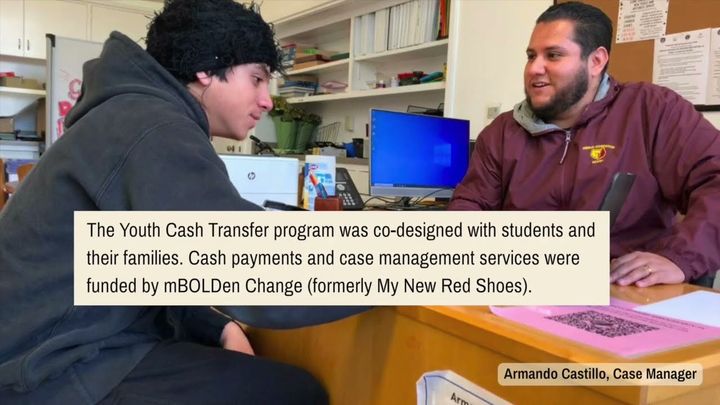
A dedicated case manager supported students and their families, setting goals with each student, checking in regularly and connecting families to tutoring, mental health care, food and housing help.
Their cycle of success
Students who reached an education goal they set with their case manager, such as a target GPA, received a $1,000 bonus at the end of the school year, on top of their monthly cash.
Insights
What We Learned
Cash and support work together.
Students rated the monthly cash and their case manager as equally important. The evaluation found both were crucial to the results.
A cycle of success.
The money got students started. Then they saw their grades rise, often for the first time, and kept going because they believed success was possible.
Students spent on essentials and their families.
Food was half of all spending. Two in three students used some of the money to help their families with rent, groceries and bills.
A bank account built real skills.
Students learned to budget and save, and nearly half saved more than $100.
One year is not enough.
These students faced homelessness, mental health challenges and gaps in their schooling. The evaluation found the impact is likely to grow when students take part across more years of high school.
Watch · 13 min
Hear From the Evaluator
Nicole Fabrikant, founder of Program Evaluation & Insight, walks through what the evaluation found, why cash and case management worked together and what the program could mean for students over the long term.
- 01:01What was notable about the impact?
- 07:01Enabling a cycle of success
- 08:34What are the potential long-term outcomes?
In Their Words
Ready to Grow
What the Next Phase Needs
The model is ready for a funding partner who wants to take it further.
More years
Support students across more of high school, not a single year.
More students
Reach a larger group, which also makes stronger research possible.
Stronger evidence
Clear eligibility rules and surveys at the start and end, so results can be compared with students outside the program.
Talk with Sue Sutherland, Director of Advancement, at sue@mboldenchange.org.